Pacific & Diaspora
Summer carols and worldwide connections
Australia & New Zealand
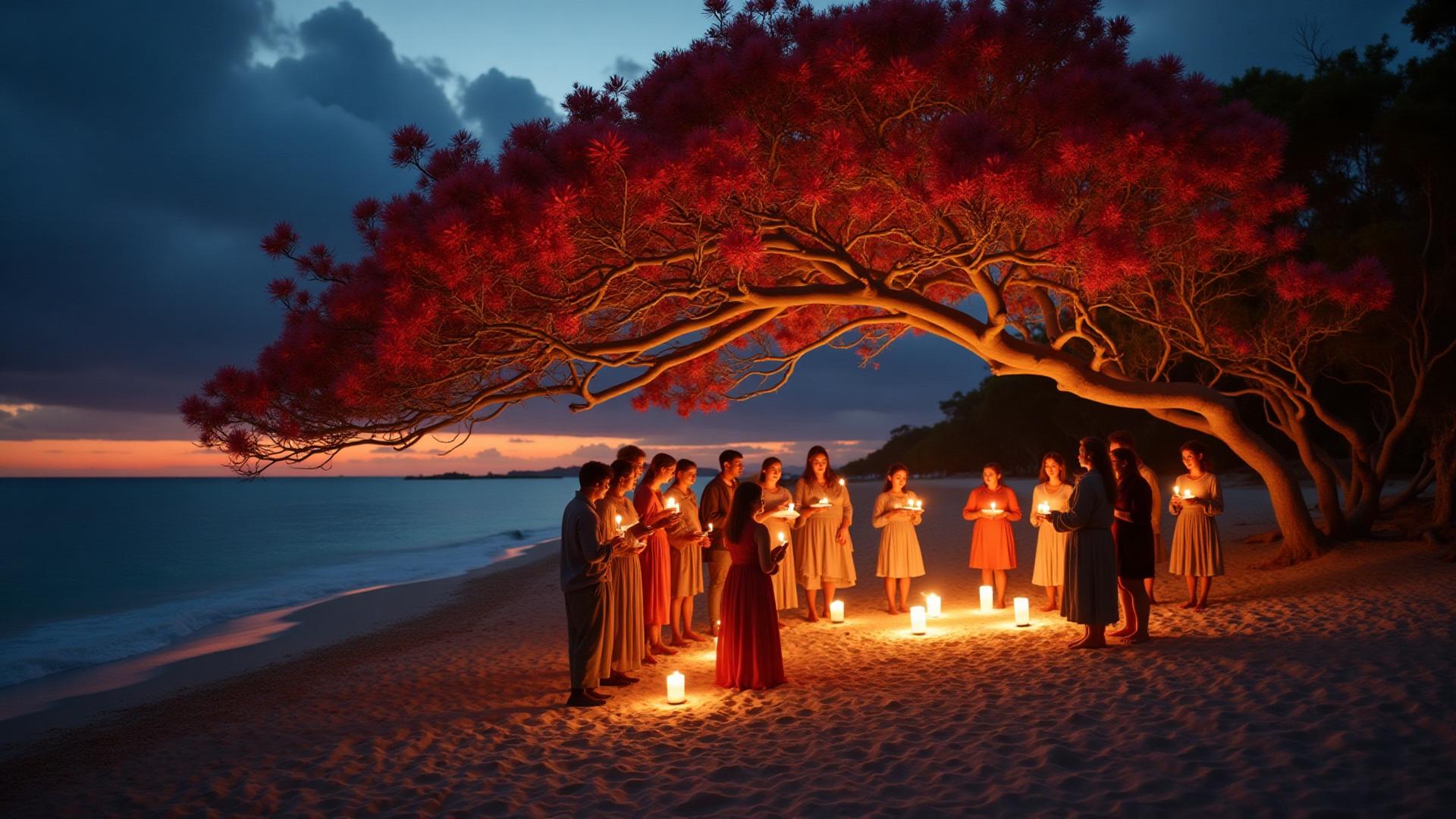
In Australia and New Zealand, Carols by Candlelight is huge. But also, communities often sing carols on the beach or at barbecues, given the summer weather! Australians even have some humorous "Aussie Jingle Bells" lyrics about dashing through the bush in a rusty Holden ute (utility vehicle) – showing how carols adapt to local culture (no sleighs in the Outback).
In New Zealand, you might hear carols in the Māori language – e.g. "Te Harinui" is a well-loved NZ carol telling of the first missionary arriving in NZ (the word harinui means great joy). Also, some Southern Hemisphere carols adjust imagery: one NZ carol "Te Ao was Filled with Singing" references "pōhutukawa" (the NZ Christmas tree that blooms red in December) instead of snow.
The famous Melbourne Carols by Candlelight in Australia is broadcast live across the country, featuring pop stars and opera singers singing sacred carols and secular favorites to huge crowds with candles, organized by Vision Australia as a charity fundraiser.
Diaspora Traditions
One of the most heartwarming aspects of global caroling is how immigrant communities bring their carols with them. A British expat service in, say, Hong Kong might closely mirror an English cathedral service – with expat choirs singing Once in Royal in St. John's Cathedral as palm trees sway outside.
Meanwhile, an Indian Christian congregation in London might combine English carols with a Tamil hymn. Large cities often host "International Carol Services" where readings are done in multiple languages and carols from different lands are showcased.
For instance, one might experience: First Lesson read in Chinese, followed by the choir singing "Angels We Have Heard on High" in French (reflecting the global church), then later a Spanish carol "Campana sobre Campana", etc. These events celebrate the universality of the Christmas message through the diversity of music.
Global Unity in Song
Perhaps the most touching demonstration of cross-cultural caroling happened during the COVID-19 pandemic: virtual choirs brought together singers from many countries to sing carols like "Silent Night". People submitted videos from dozens of nations, all combined to form one global chorus – literally illustrating different accents, languages, skin colors, all harmonizing on "sleep in heavenly peace."
Carols themselves have traveled – consider "Silent Night" again, originated in German but now sung by millions in their mother tongues. Or "The First Noel" from England being sung in a Kenyan village church. Even secular tunes like "White Christmas" might be played in a Japanese department store. Christmas music is a kind of cultural ambassador, crossing borders easily because the feelings it conveys – hope, peace, joy – are understood by all humans.
A Common Language
When you attend a carol service abroad, you realize the essence is the same: candles may be replaced by fairy lights or flashlights in some places, the weather might be snowy or tropical, the language different, but people still gather to hear those ancient Bible readings and to sing songs of a birth that symbolizes hope.
Often the final carol transcends language – "Silent Night" is often chosen for multi-lingual services, with each verse in a different tongue, then everyone humming together on the last. It's goosebump-inducing to hear a hush of multilingual humanity humming that melody together – truly a global harmony.