Asian Traditions
From tropical dawn masses to mountain temples
In predominantly Christian parts of Asia, carol services flourish with local touches, blending ancient traditions with Christmas celebrations in unique and beautiful ways.
The Philippines - Simbang Gabi
The Philippines stands out: a predominantly Catholic country with a passion for Christmas like no other. Starting December 16, many Filipinos attend Simbang Gabi – a novena of pre-dawn masses for nine days leading to Christmas. These masses are often at 4 or 5 AM, and though they are Masses (not exactly lessons-and-carols), they are full of carol singing and festive hymns.
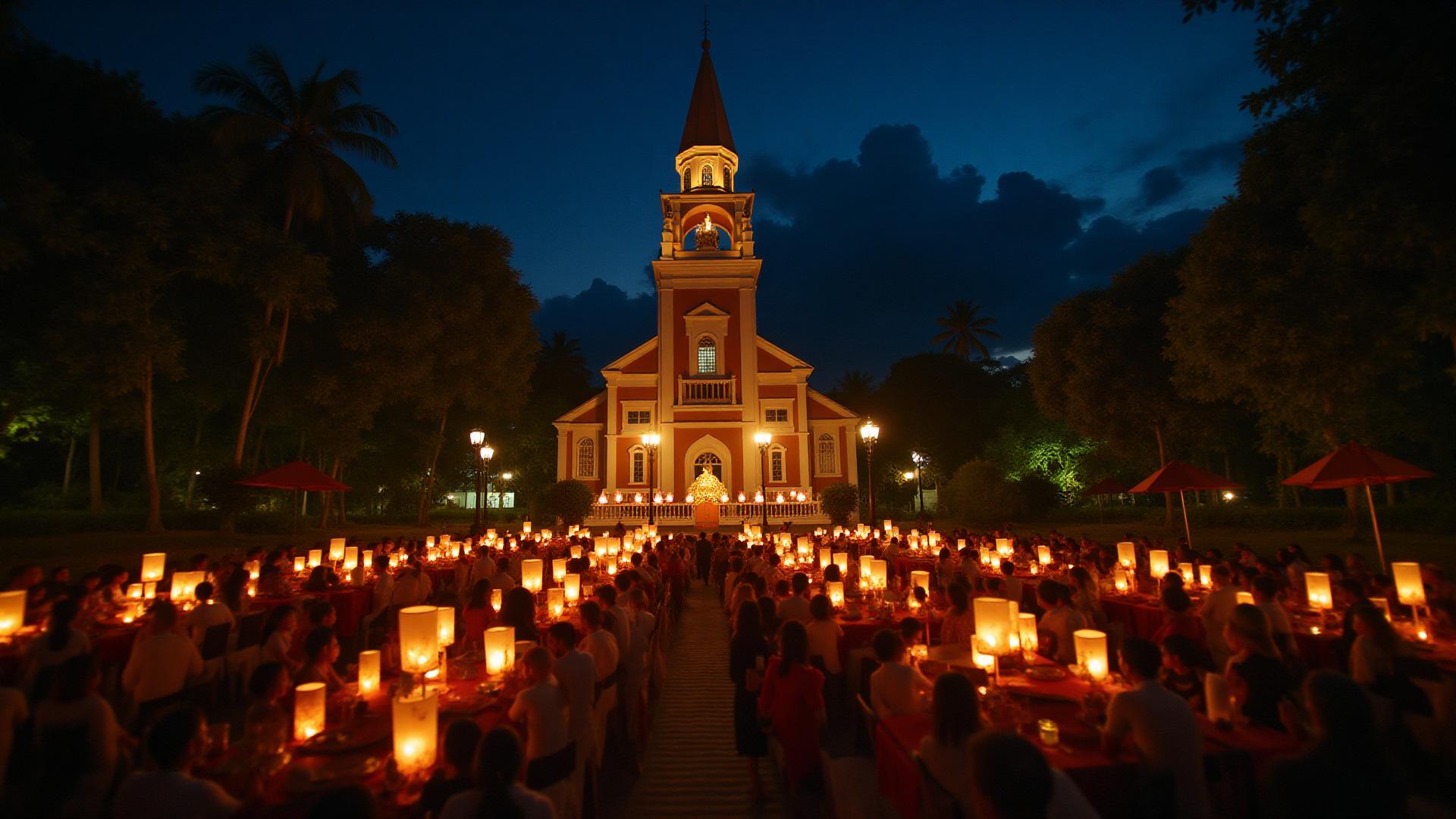
Imagine a tropical predawn with stars still out, the church aglow with paról (star lanterns), and a choir singing "Pasko Na Naman" (a popular Tagalog carol) or "Ang Pasko ay Sumapit" (another lively carol). The faithful believe completing all nine dawn services brings special blessings, and the culmination on Christmas Eve (Misa de Gallo) is joyous.
Sometimes, after these masses, communities share rice cakes and hot chocolate outside – a blend of fellowship and fiesta. A carol service under the stars in the Philippines might also involve traditional dances or a tableau of the Nativity enacted by local youth.
India
In India, particularly in Goa and the Northeast states, Midnight Mass on Christmas Eve includes singing carols in English and local languages (like Konkani or Hindi). It's not uncommon to hear "Joy to the World" followed by a lively chorus of "Khushi navu janam" (a Hindi carol), maybe even accompanied by tabla and harmonium alongside organ.
Indian Christians have also composed original carols – for instance, there's a beautiful Marathi carol "Bethlehemchi Paris" that some services include. Carol singing groups in India might go around to Christian households in the neighborhood – an import from British times – and they often carry a star-shaped lantern as they sing.
Japan
In countries where Christians are a minority, carol services take on a slightly different cultural role. In Japan, only about 1% of the population is Christian, but Christmas is celebrated in a secular way by many. Churches do hold Christmas services and concerts (for the Christian community and curious friends), and interestingly, Japanese Christmas Eve is also a romantic holiday for couples, akin to Valentine's Day.
A noteworthy tradition: singing Beethoven's 9th Symphony ("Ode to Joy") in chorus in December is huge in Japan – not a carol, but it's treated as a year-end musical ritual. As for actual carols, the Japanese have translations of standard carols (e.g. "Kiyoshi kono yoru" for Silent Night).
And in public, one hears a lot of secular Christmas songs in shopping districts. But within churches, a small but devoted number sing carols and often put on multi-lingual services (for expatriate communities, etc.).
Korea
Korea has a larger Christian population, so Christmas is more openly religious for many. Korean churches often have vigorous choirs that sing Korean lyrics to O Holy Night or Hark the Herald. Korean compositions like "Joyful Day" also become part of church carol repertoires.
A Universal Spiritual
One cross-cultural carol standout is "Go Tell It on the Mountain" – an African-American spiritual that has found its way into hymnals worldwide. You might hear it sung in a Maasai church in Kenya, a Māori choir in New Zealand, or a youth band in Singapore – each adding a bit of their flavor. The refrain "that Jesus Christ is born" is universal, even if the musical style shifts.